Things to do
Minh Thành Pagoda in Pleiku
A red nine-storey stupa and a Japanese-looking roofline, 2 km from central Pleiku. Free entry, 7 am to 5 pm, what to see first, what to wear and where to eat.
By the Xin chào Pleiku editorsRechecked
On this page
Curved roofs, bracket arms and a red tower on the plateau make Minh Thành Pagoda look almost like a Japanese temple. But it is first of all a place where Buddhists come to pray. Below: how to get there, what to see, when to go, what to wear, where to eat afterwards and what to pair it with.
Getting to Minh Thành Pagoda from central Pleiku
The pagoda is about 2 km south-west of the centre; type 348 Nguyễn Viết Xuân into your phone map and you are there. A Grab or a taxi is easy, and you can carry on elsewhere the same day. A traditional motorbike taxi charges about 7,000-10,000 VND per km (October 2026); agree the fare before you get on.
| What | Detail |
|---|---|
| Address | 348 Nguyễn Viết Xuân, Hội Phú ward |
| From the centre | about 2 km |
| Hours | 7 am to 5 pm daily |
| Entry | free |
| Area | nearly 2 ha |
What to see first once you are through the gate
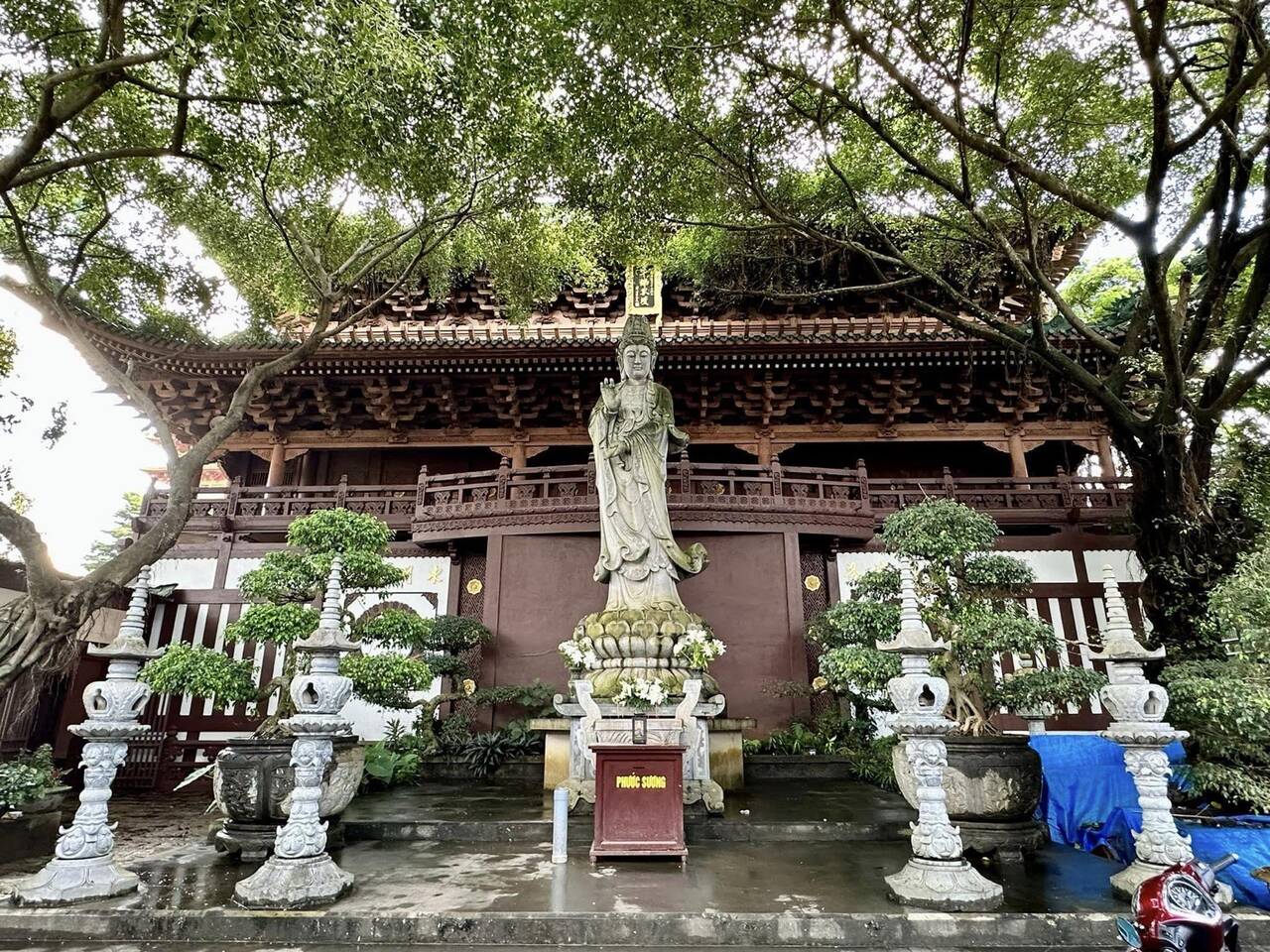
From the gate, walk straight to the main hall. The complex is called the “seven-part temple” (thất trùng già lam), seven clusters of halls, each with its own meaning. See the main hall first, then branch out to either side.
The main hall is 16 m high with a ceiling of pơ mu wood, and stop at the carved wooden doors showing the Four Heavenly Kings: they stand 6 m tall, extremely thick, and are counted among the largest door sets in Vietnam. Inside, four statues of the thousand-armed Guanyin, each 8 m tall, stand at the four corners of the hall. Along the walls are more than 3,000 Buddha statues, so stand a while and you keep spotting new details.
Liên Trì pond, the Amitabha statue and the incense burner
Right in front of the main courtyard is Liên Trì pond, where a stone Amitabha Buddha, 7.5 m tall and weighing 40 tonnes, stands in a pond of pink lotus. In front of it is a bronze incense burner 4 m high and weighing more than 4 tonnes. From the edge of the pond you can get the stone statue and the lotus water in a single frame.
The Relic Stupa
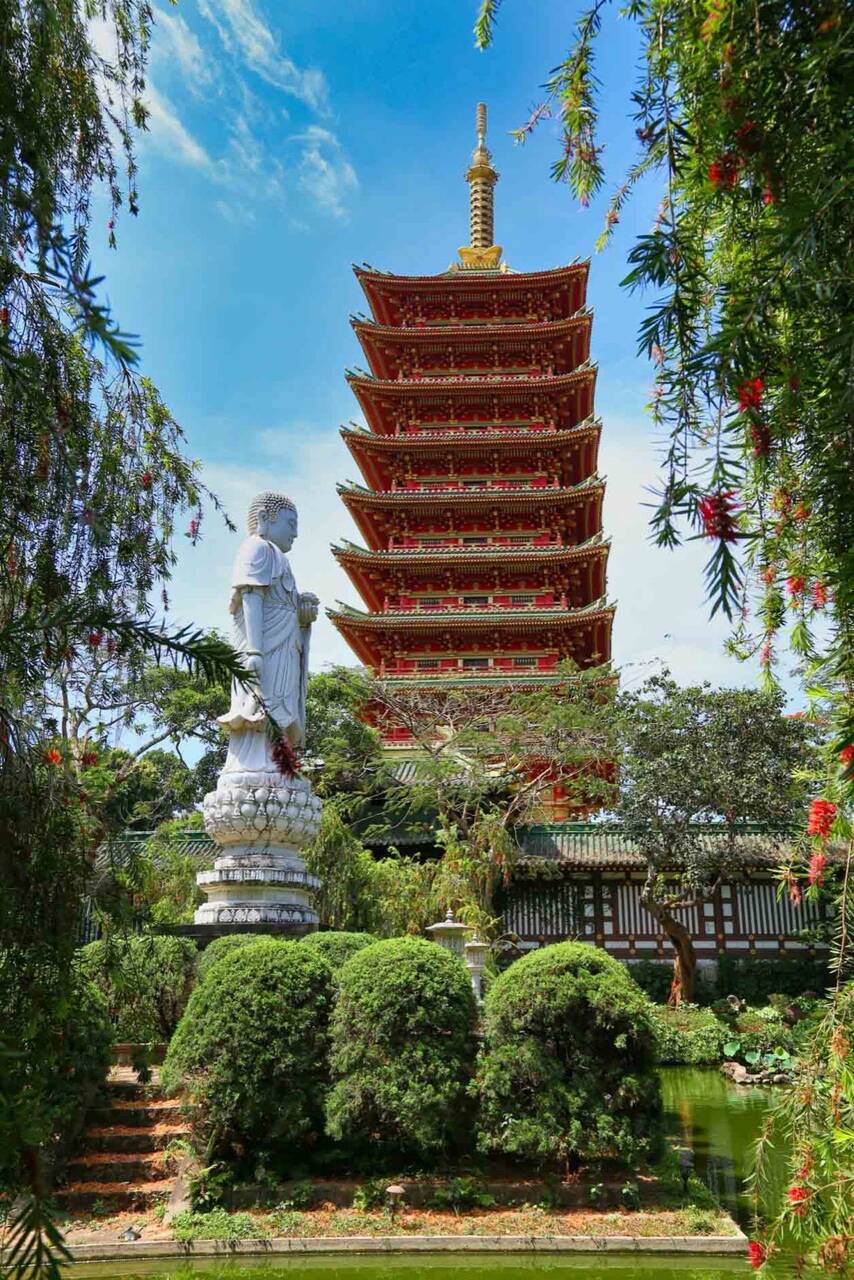
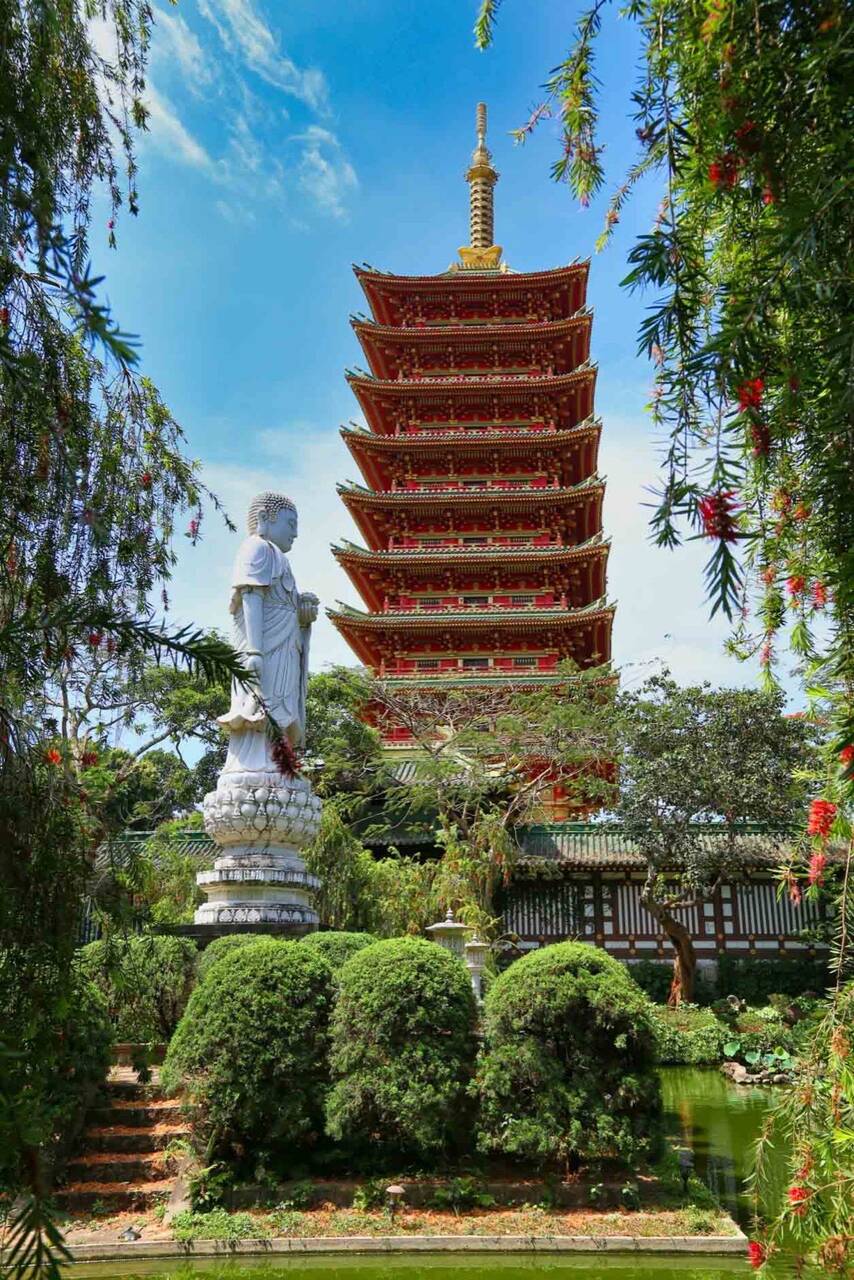
Seen from a distance, the pagoda’s signature is the nine-storey stupa, more than 70 m tall. Inside are four thousand-eyed, thousand-armed Buddha statues in jackfruit wood, and the stupa holds more than 10,000 sets of Buddhist scriptures. For a photo with both stupa and statues, stand across the pond and look over to it.
The bell tower and Tu An tower
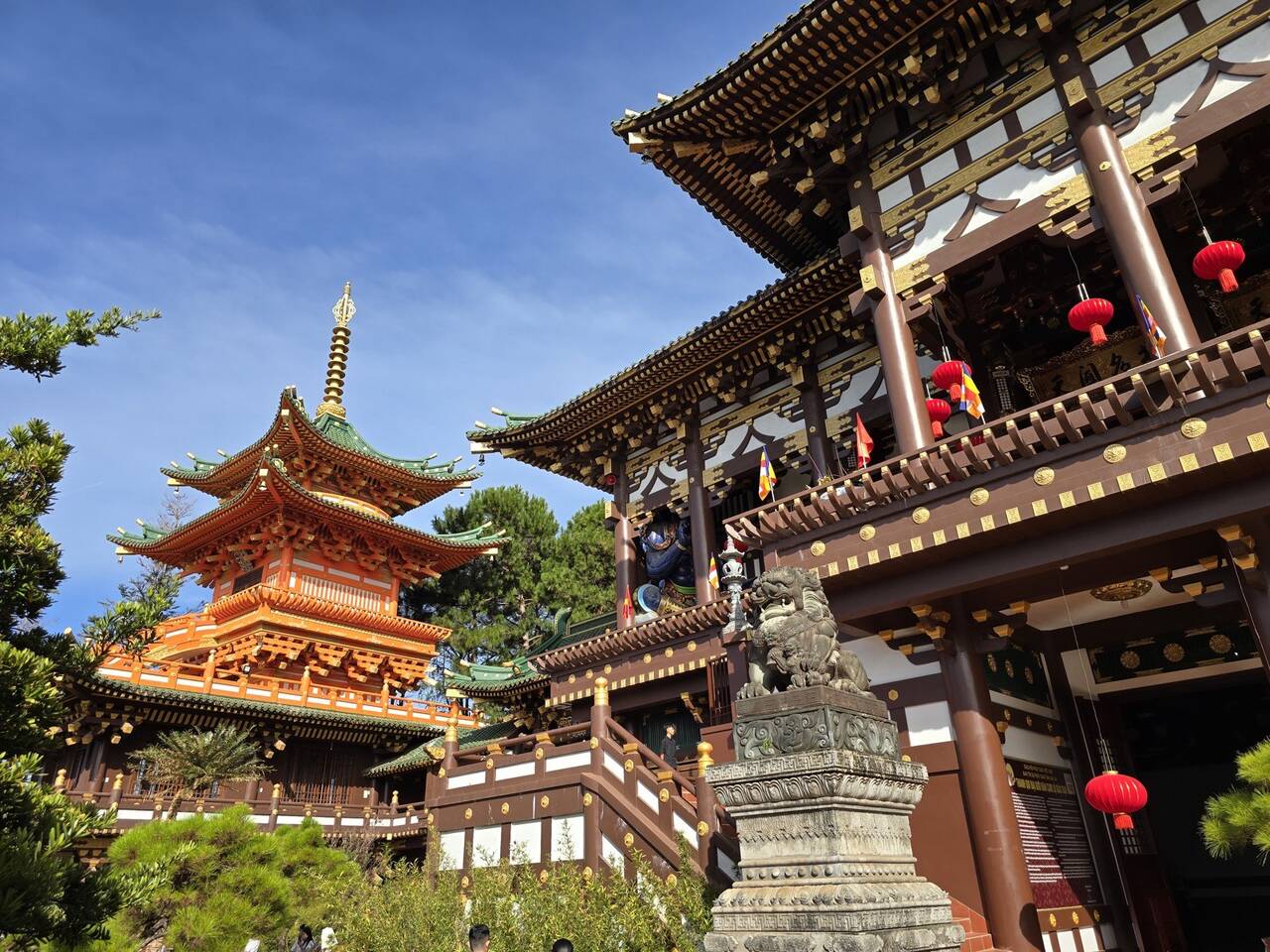
In front of the main hall, on either side, stand the bell tower and the tower of the founding patriarch.
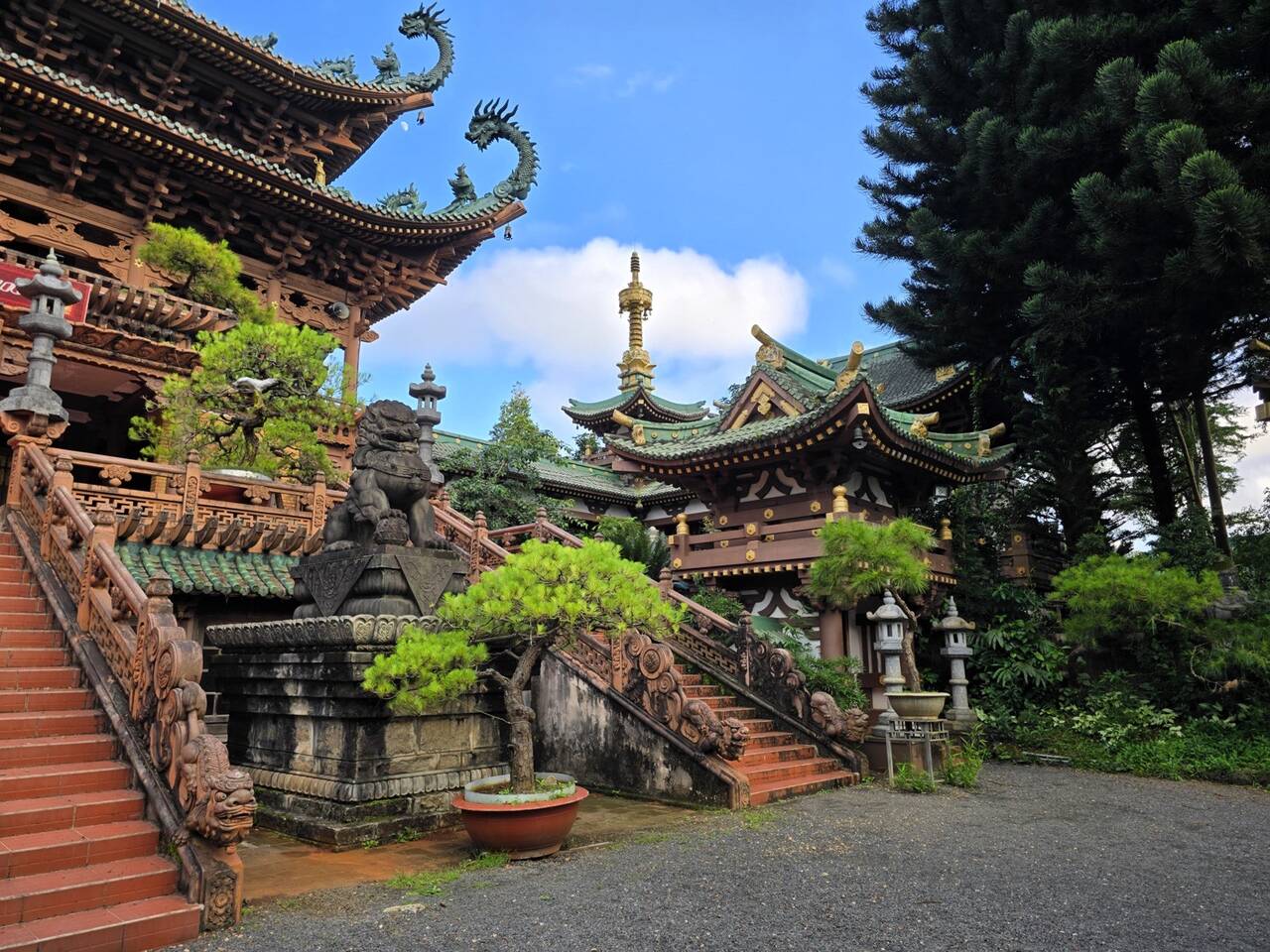
The pagoda closes at 5 pm, so do the main hall first and wander the rest of the grounds after.
When the pagoda was built and why it looks Japanese
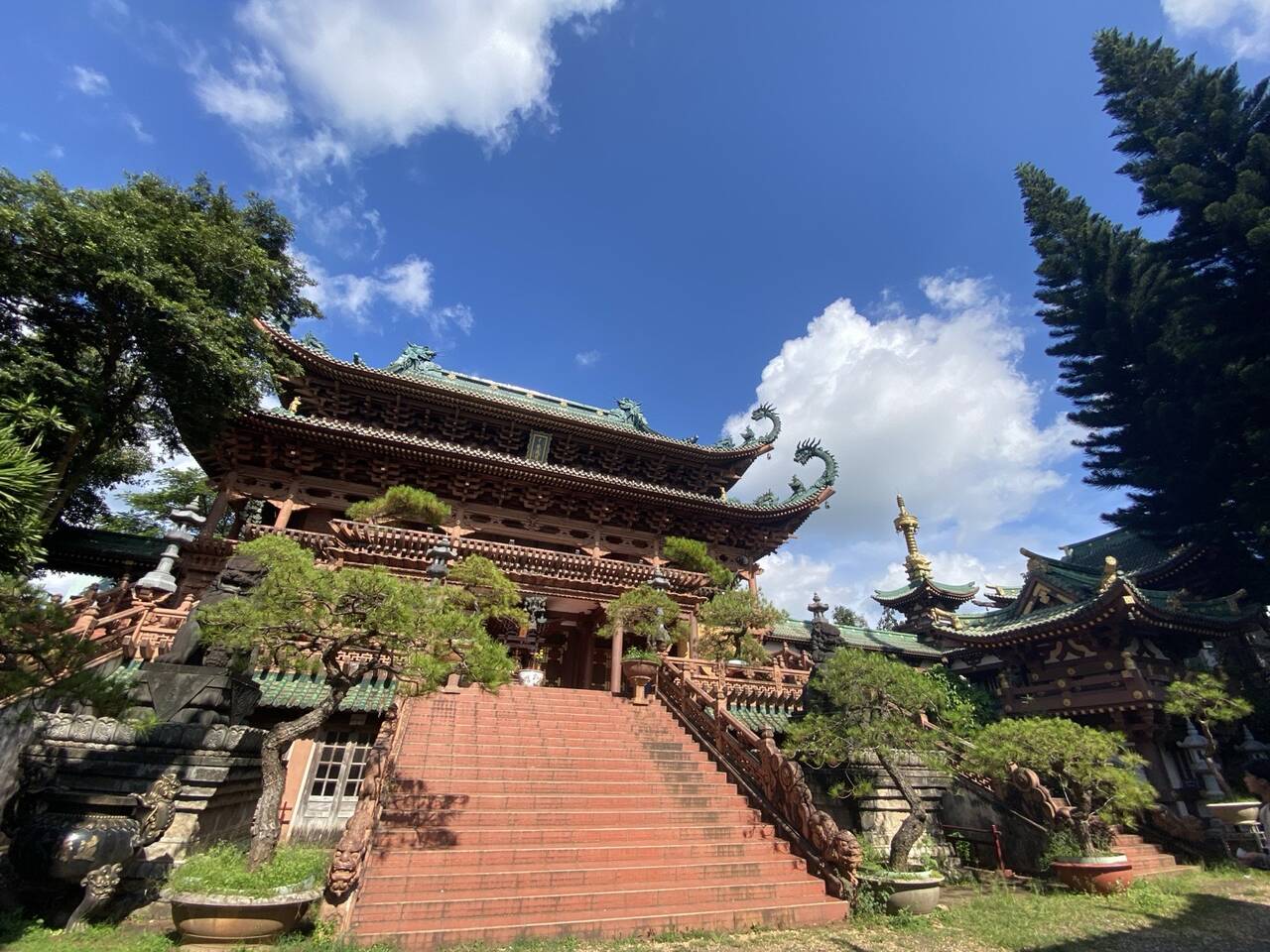
Why does a highland pagoda look like a Japanese temple? It was built from 1964 by the Venerable Thích Giác Đạo, restored and rebuilt from 1997 in work that lasted more than 10 years, and in the last 20 or so years rebuilt on a large scale under the abbot, the Venerable Thích Tâm Mãn.
The architecture draws mostly on Lý and Trần dynasty pagodas, with touches of Chinese temples and Japanese shrines, and some Taiwanese influence. The main hall is laid out as a simple mandala, a circle standing for a lotus in full bloom. That is why the curved roofs and multi-storey stupa remind you of Japan, while the layout and carving belong to Mahayana esoteric Buddhism.
What time to go
Go in the morning, when the light is soft and it tends to be quieter. The pagoda lights up at night and looks magical, but the gate is listed as closing at 5 pm, so phone before you plan an evening visit. There is enough detail here to take a while, so do not squeeze it into a packed schedule.
What to wear and how to behave
This is a place of worship, so dress modestly, walk gently, speak softly and keep your language clean. Do not touch statues, objects or offerings, and ask before taking photos. Keep food and drink out of the main hall, and if you offer incense, do not burn too much.
Some areas have their own rules and are not open to everyone, so read the notice boards or ask the abbot.
Where to eat afterwards
For a bite close by, Phở Khô Gia Lai - Hùng Ròm is at 127 Trường Chinh, in the same ward, open 5:30 am to 9:30 pm daily. Order the tái khô (dry phở with rare beef) with a little soy sauce: about 40,000-45,000 VND a bowl, 5,000 VND for a fried dough stick (prices from June and July 2026). First dry phở? The owner will show you how to mix it.
For more places across the city, read our Gia Lai dry phở guide.
Pairing the pagoda with the square and Plei Ốp village for a day
All three stops are close to the centre: Great Unity Square (Đại Đoàn Kết) is in the middle of the city, near National Road 14, and Plei Ốp village is close to the square, the provincial museum and Minh Thành Pagoda itself. A day could run like this: pagoda in the morning, phở in Hội Phú, Plei Ốp village in the afternoon, then back to the square.
Routes, tickets and show times for each are in our Great Unity Square guide and our Plei Ốp village guide. If you have another half day and want to head north, read about Biển Hồ Lake; everything else is in the things to do section.
Read next
- Great Unity Square in PleikuThings to do
- Plei Ốp village: a Jrai village inside PleikuThings to do
- Biển Hồ Lake (T'Nưng) near PleikuThings to do
Sources
(11)
- Kiến trúc độc đáo của chùa Minh Thành ở phố núi Pleiku (20/02/2019)
- Độc đáo kiến trúc Phật giáo tại Pleiku
- Khám phá chùa Minh Thành phong cách Nhật Bản giữa phố núi Gia Lai
- Minh Thành Pagoda (dữ liệu địa điểm Google Maps, đọc 25/10/2026)
- Sân bay Gia Lai: Vị trí, cơ sở hạ tầng, các chặng bay
- Review Phở Khô Gia Lai - Hùng Ròm, đến 20/10/2026
- Giờ mở cửa các quán phở khô, đọc ngày 25/10/2026
- Địa chỉ các quán phở khô Pleiku
- Làng trăm tuổi của đồng bào J'rai giữa lòng Pleiku
- Quảng trường Đại Đoàn Kết
- 2 địa điểm chụp ảnh Tết tuyệt đẹp được giới trẻ Gia Lai yêu thích
Photos
(5)
Binh Nguyen · Hằng Lê Thị · Ho Ngoc Tin · minh le · RenOverSea
Spotted an error? Send a correction · How we choose sources