Seasons & festivals
Gongs in Pleiku: where to hear them
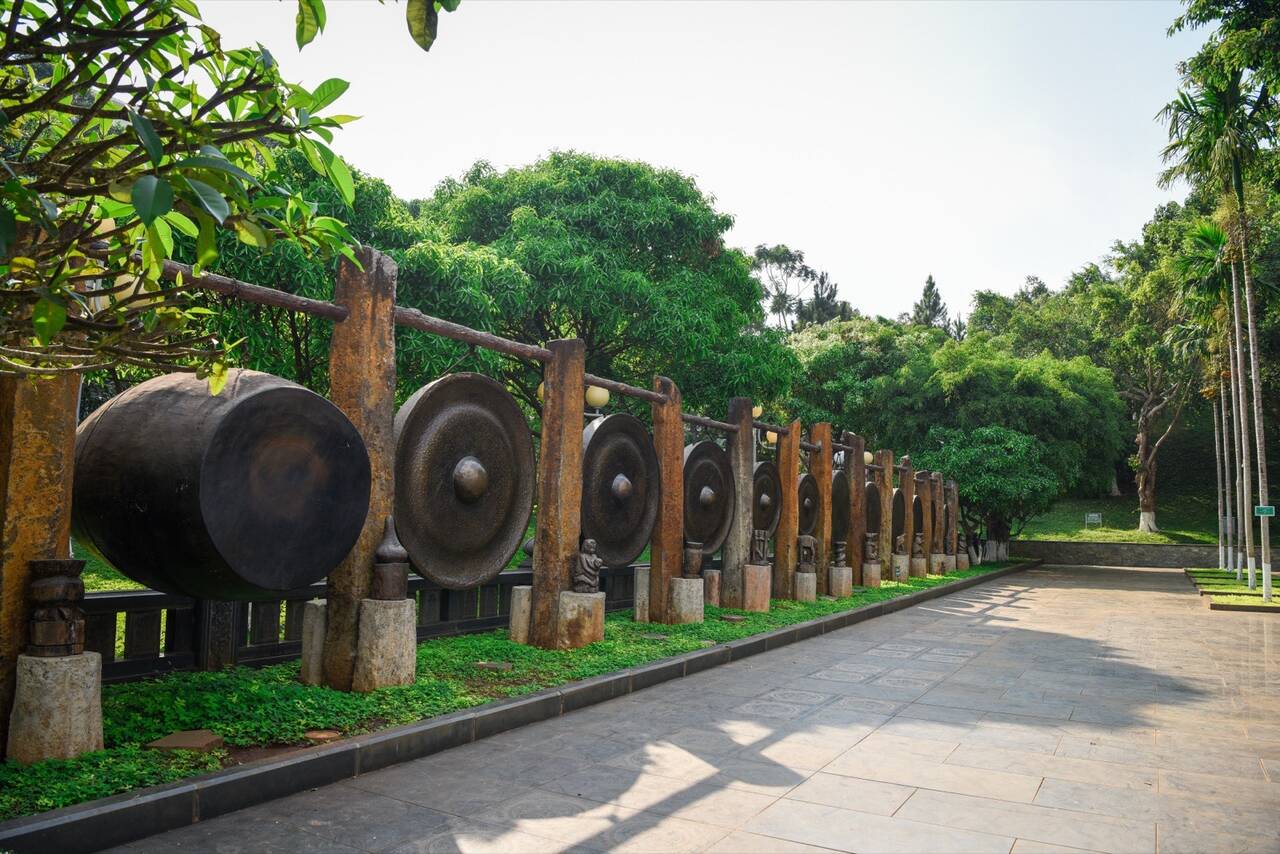
Hear Central Highlands gongs live in Pleiku on Saturday nights or at the festival, then see the museum, communal houses and tomb statues.
By the Xin chào Pleiku editorsRechecked
On this page
- Saturday night at Great Unity Square
- The gong festival, 30 October to 8 November
- What the gongs are, and what UNESCO recognised
- What the gong means to the Jrai and Bahnar
- Pleiku Museum: gongs, drums, jars and models of tomb houses
- The communal house: which village to visit
- Tomb houses and wooden statues: how to look at them
- Brocade, rice wine and the village meal
- In the village, the communal house and the tomb-house area: how to behave
- A Saturday in Pleiku
Your two best chances to hear Central Highlands gongs played live in Pleiku are a Saturday night at Great Unity Square and the gong festival at the start of November. The rest of the time, the museum and the villages of Plei Ốp and Kép show you the instruments, the communal houses and the tomb statues around them. The page goes in the order that is easiest to do, then explains what you are hearing and how to behave in a village.
Saturday night at Great Unity Square
If you only have one evening and it is a Saturday, go to the square. The weekend gong programme plays at Great Unity Square (Đại Đoàn Kết), from 7 to 9 pm every Saturday and on related holidays and events, from March to December 2026. The fixed schedule means you never have to chase a festival calendar, and if you miss one Saturday there are plenty more. Recent evenings brought more than 50 Bahnar artisans from Piơm village, Đak Đoa commune.
Our pick for the hour before. Have a cocktail at sunset at Pleiku Balcony, which opens in the afternoon. Brad, the Australian owner, lives in Pleiku and speaks English.
How to get there, where to park and what is around the square are in Great Unity Square.
The gong festival, 30 October to 8 November
Be in town at the start of November and the festival is the biggest gong event you can catch. The Gia Lai international gong festival is planned for 30 October to 8 November, with about 45 troupes of artisans from Vietnam and abroad. It is the first gong festival of this scale for Gia Lai, at national and regional level, part of the 2026 National Tourism Year and a marker of 21 years since UNESCO recognised the gong space.
| Date | Where | What |
|---|---|---|
| 30 October to 1 November | Ia Gri village, Biển Hồ commune | Instrument demonstrations; a rebuilt Jrai ceremony for a new communal house; an exhibition on gong culture in Gia Lai |
| 6 November | Streets of Pleiku, Diên Hồng and Hội Phú wards | Street festival, artisans in traditional dress |
| 6 to 8 November | Great Unity Square and Pleiku Museum | Cultural exchange and performances by the different ethnic groups |
| 7 November, 8 pm | Great Unity Square | International gong night |
If you can only go once, make it the evening of 7 November at the square, the high point of the festival; the plan is to present the national treasure decision for the Kơ Đơ gong set that same night. If you would rather watch artisans at work, pick 30 October to 1 November in Ia Gri, where the troupes build small villages with gong playing, gong tuning, statue carving, weaving, basketry and rice pounding. You can talk to the artisans there and see how instruments and crafts are made. There is also a food area with dishes from the provinces and countries taking part.
These dates are the province’s plan, so book a room you can change and check again as your trip gets close. The other dates in the year are collected in the Gia Lai festival calendar for 2026. If you come when the wild sunflowers bloom, read the dã quỳ season in Pleiku too.
What the gongs are, and what UNESCO recognised
A gong night is better when you know what you are listening to. UNESCO inscribed the Central Highlands gong space on 25 November 2005. It was first a masterpiece of oral and intangible heritage, and in 2008 it moved to the Representative List of the Intangible Cultural Heritage of Humanity. It was Vietnam’s second UNESCO heritage, after Huế court music.
What was recognised is a whole space, not one instrument. It spreads across five Central Highlands provinces, Kon Tum, Gia Lai, Đắk Lắk, Đắk Nông and Lâm Đồng, and belongs to more than ten ethnic groups. Gia Lai has the largest Bahnar and Jrai populations, and these two groups play the biggest gong sets, with very complex orchestras. The scale does not follow the Western tempered system, so do not expect it to sound like a tuned piano.
Gongs here are common. Before the provincial merger Gia Lai had more than 5,600 sets, many of them hundreds of years old. Pleiku city alone had 25 gong teams and 157 sets, with more than 500 gong and xoang dance artisans. The city also runs a yearly gong festival and gong classes for teenagers. Roh village, in Pleiku ward, has an ensemble that stands out at the province’s ethnic minority culture days.
What the gong means to the Jrai and Bahnar
At the square you watch a performance. For the Jrai and Bahnar the gong is more than an instrument: it is sacred, and it goes with a person from birth to joining the ancestors. Gongs mark a life from the ear-blowing ceremony to the wedding. At the new-rice festival they tell the farming spirit about a good harvest, and at the grave-abandonment ceremony they see the dead off to the other world. Without gongs, those rites lose their sacredness. Even in the middle of Pleiku, Jrai and Bahnar families still treat gongs as a priceless heritage tied to daily life.
That is why gongs once sounded only on big occasions. Today villages play for visitors, as long as the gongs remain the soul of the village. It is not easy to keep, because some young people are less tied to community life. Some villages have started clubs so the young can learn, such as Krái village in Chư Păh commune, with 45 members, mostly young people.
Pleiku Museum: gongs, drums, jars and models of tomb houses
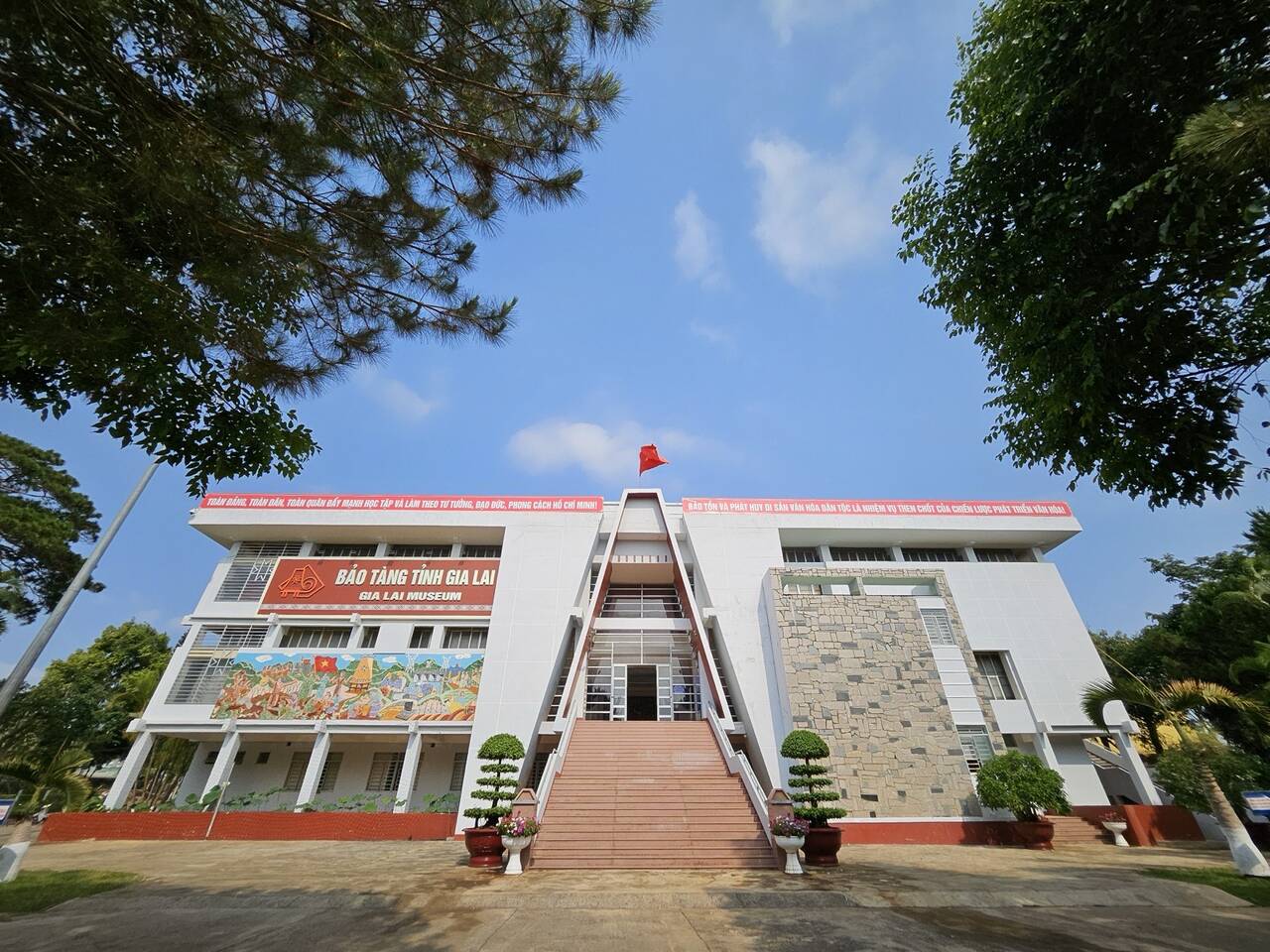
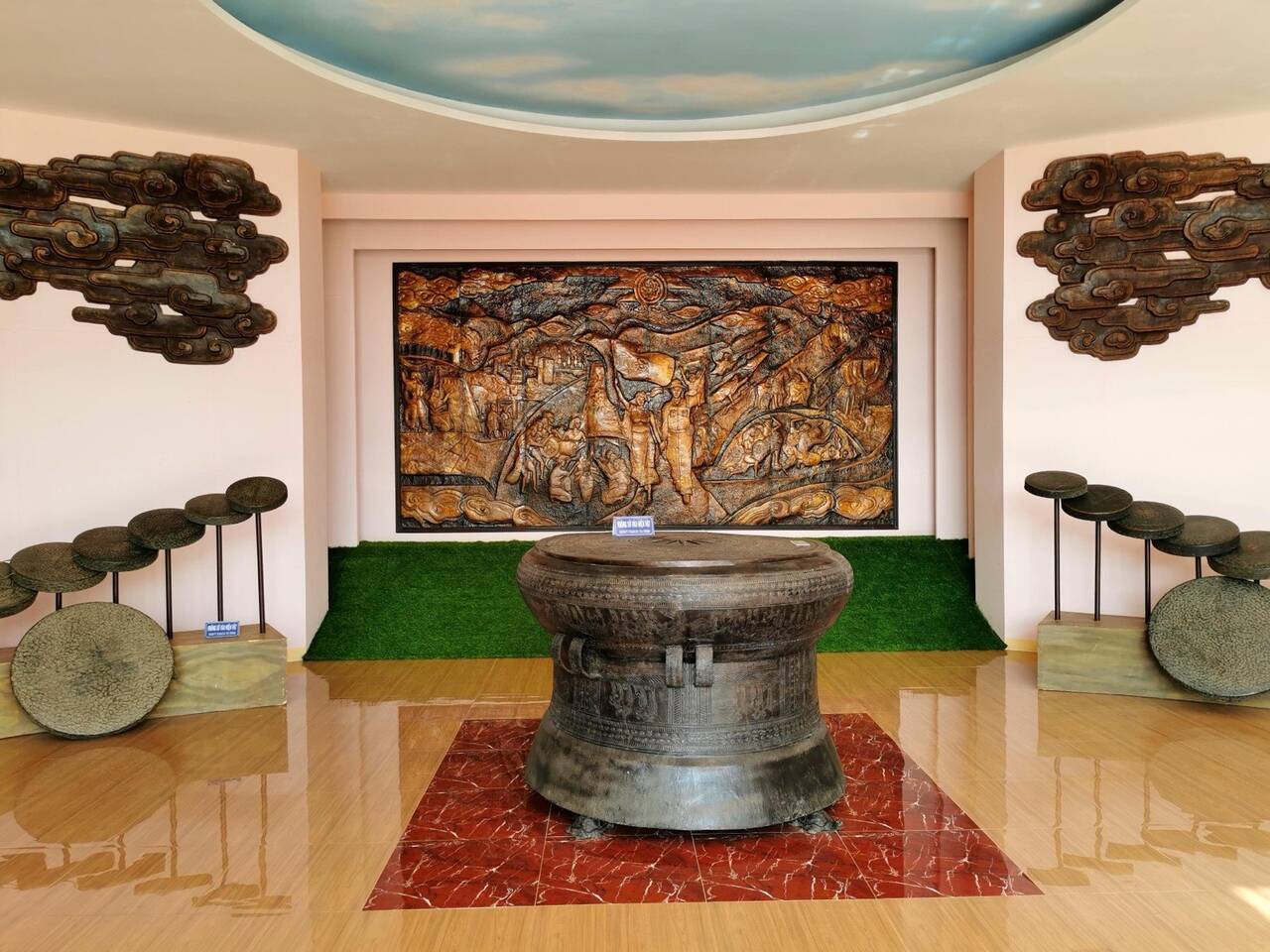
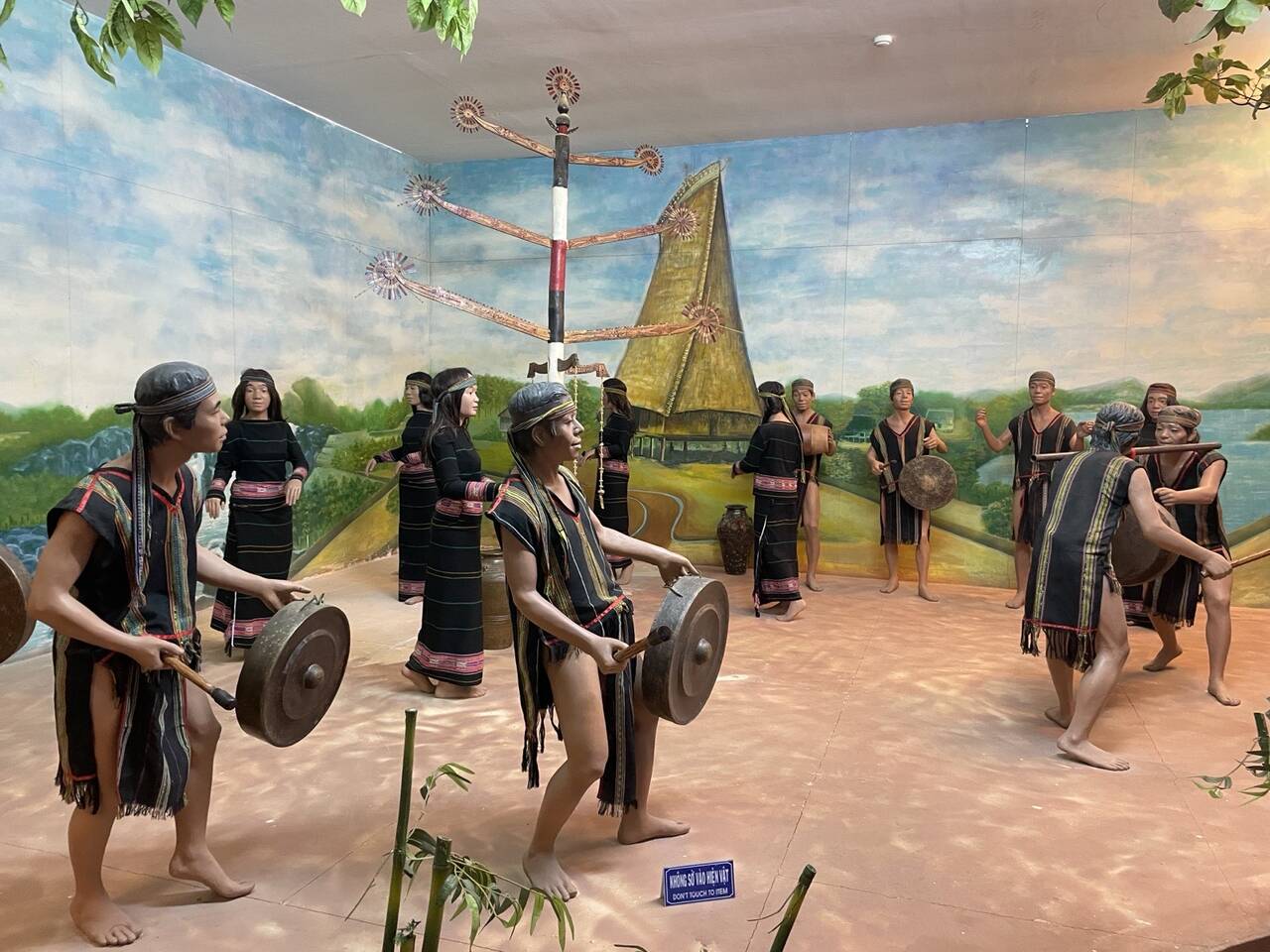
If it rains, or it is not yet Saturday, the museum is the place to see real gongs up close. It is right beside Great Unity Square, at 21 Trần Hưng Đạo. It is open from 7:30 to 11 am and from 1:30 to 4:30 pm every day except Monday. An adult ticket is 10,000 VND (October 2026) and children under 16 get in free; buy it at the museum.
Inside you will find a collection of gongs, a collection of big Jrai and Bahnar drums about 1 m across and a set of rare old jars, with models of tomb houses and stilt houses. There is a separate room on the gong space. The main hall shows two valuable Gia Lai gong sets, and another hall has gongs and the tools used at festivals. In the grounds is the Antiques Museum, converted from Hộ Quốc Pagoda, with nearly 400 ceramic pieces and sets of jars. Each jar can have its own name, origin and value. They are not just containers: jars appear in the ear-blowing, wedding, grave-abandonment, new-communal-house and new-rice ceremonies, and are tied to the gong space.
The museum has simple rules: do not touch the objects or equipment, keep it clean, no snacks, no smoking, no noise. If you want to film or take photos, contact the museum reception.
One trap: the Gia Lai provincial museum is now at 26 Nguyễn Huệ, Quy Nhơn ward, while the one in Pleiku is at 21 Trần Hưng Đạo. Give your Grab driver the Pleiku address.
The communal house: which village to visit
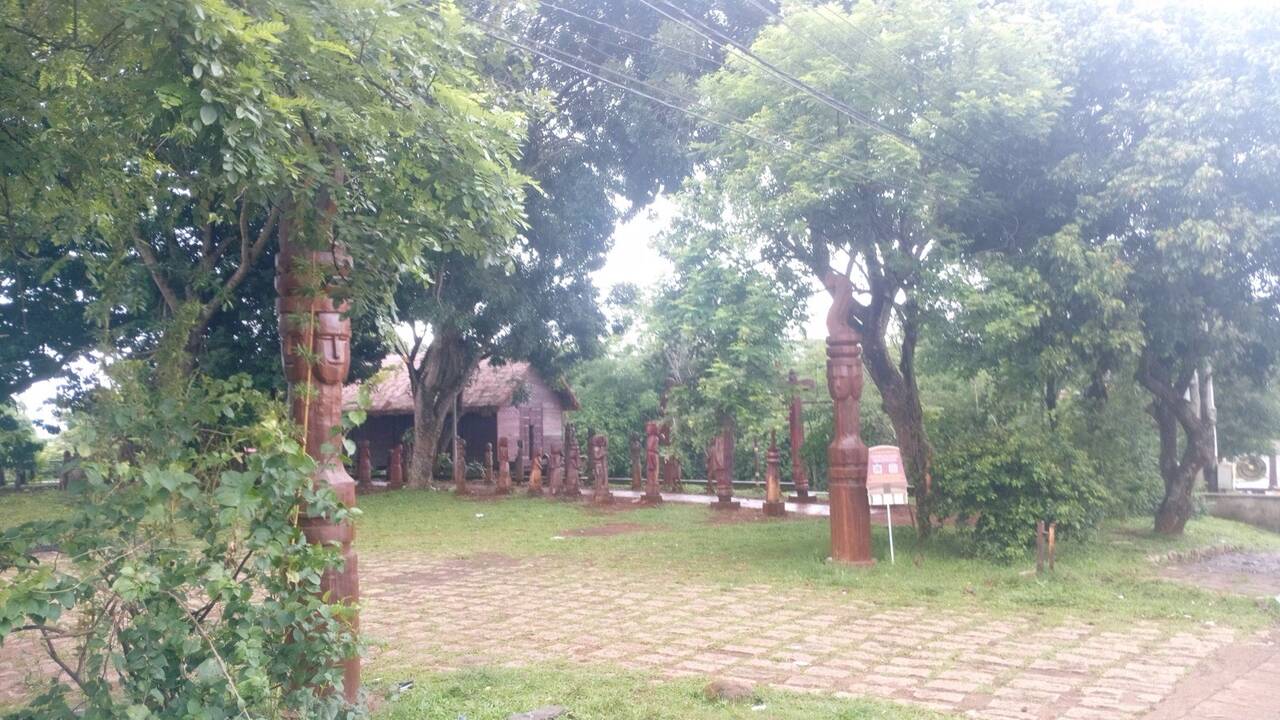
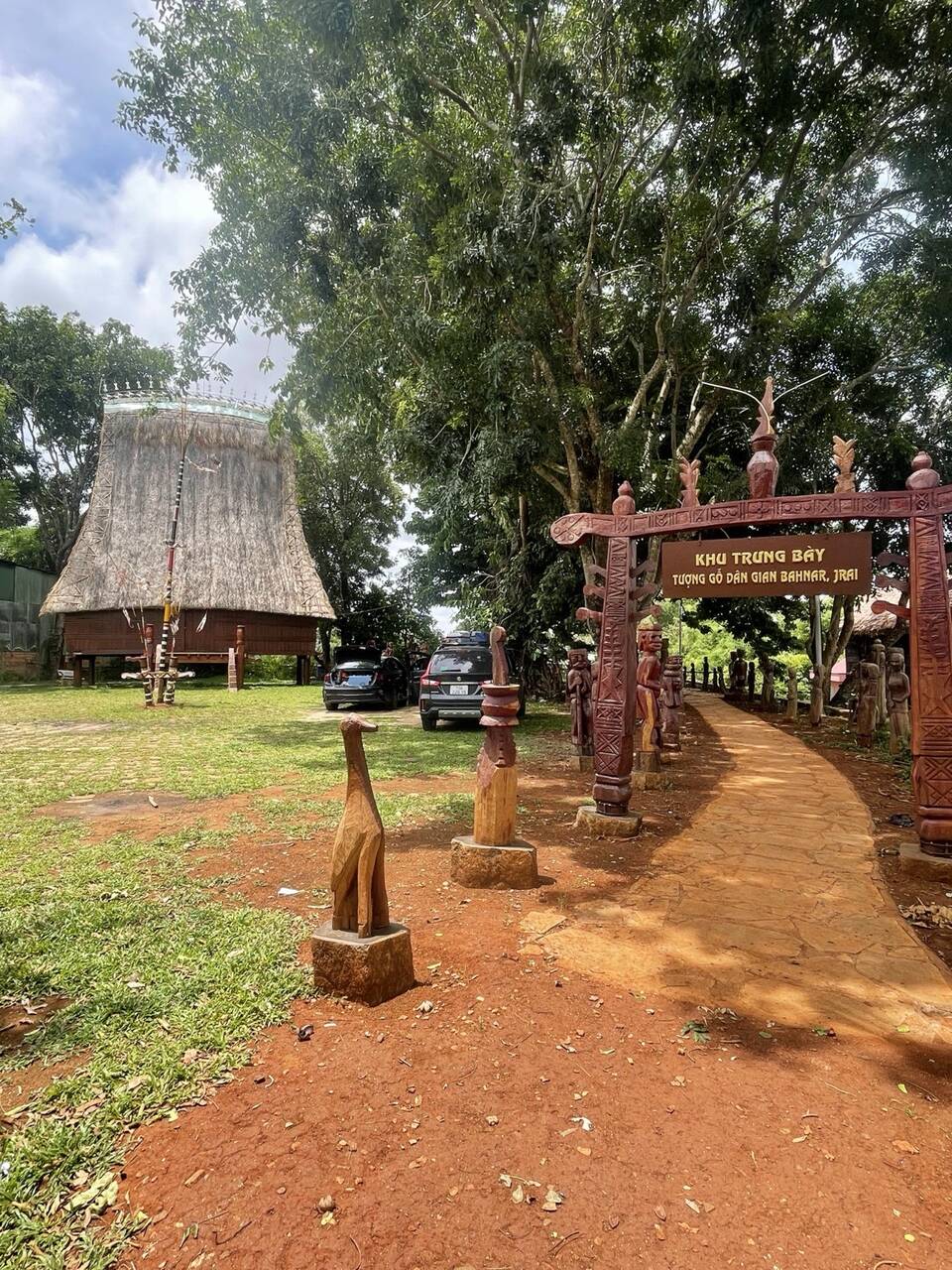
To see a real communal house (nhà rông) you need to go to a village, because it is the biggest shared space in each village. A Jrai communal house has a thin, flat roof like an axe blade; a Bahnar one is bigger, softer in line and often surrounded by stilt houses. On the stairs, the Jrai carve a water gourd and the Bahnar carve a fern tip. Visitors also come to the communal house to learn about the architecture and watch folk performances. For the Jrai it connects people with the spirits and with nature. Wooden statues belong to big ceremonies such as Pơ Thi, and decorate communal houses, stilt houses and graves.
If you have half a day in town, go to Plei Ốp village, close to Great Unity Square, the provincial museum and Minh Thành Pagoda. Its communal house has a high curved roof and a ceremonial pole, and the front yard has 54 wooden statues of the Jrai and Bahnar. Gongs sound there when the village welcomes a tour group or holds a cultural exchange. Routes and village tours are in Plei Ốp village. During the festival, Ia Gri brings back the ceremony for a new communal house, with a market of local products. If you want a longer outing, Kép village is about 25 km from Pleiku airport. It keeps over 95% of its stilt houses as living space and has taken guests as a community tourism village since April 2023.
Tomb houses and wooden statues: how to look at them
The statues in the yard are easy to photograph, but they began at the tomb house. In Jrai culture wooden statues were once only for the dead, placed at the tomb house. Today there are two kinds: those at graves, made only after the grave-abandonment ceremony, and decorative ones in tourist sites, parks and communal houses. A survey of 177 villages in Gia Lai counted about 1,500 statues.
Tomb statues tell what the living feel for the dead. A seated figure with hands over the face shows longing and grief, and a mother carrying or holding a child shows the sorrow of a widow. Around tomb houses there are also statues of rice pounding, drumming, singing and dancing, fertility and mother-and-child symbols and animals. The finer the tomb house and the more statues, the more respect the living show the dead.
You can walk into a tomb-house area at Kép village, where visitors are usually guided and told what the statues mean. The grave-abandonment ceremony (Pơ Thi) is another matter. It belongs to the family and the village: the family of the dead cuts wood, carves statues and builds the tomb house, then invites relatives and the whole village. It lasts two to three days, and the Jrai see it as the biggest and happiest festival of the year.
Brocade, rice wine and the village meal
Once you are in a village, do more than look. The Plei Ốp tour has a water-drop stop to learn the Jrai belief in many spirits, and a homestay for weaving, basketry and rice-wine brewing. At Kép you can follow brocade-making from choosing the thread through dyeing to weaving. Jrai families have passed weaving down for generations.
You may be offered rice wine (rượu cần) by a village elder. Together with gongs and xoang dancing it completes an evening by the fire. For a meal in the village, look for grilled chicken in bamboo rice, one-sun-dried beef with yellow ant salt and stream fish grilled in bamboo.
In the village, the communal house and the tomb-house area: how to behave
A few simple habits go a long way in a village, and they all come from how villagers see these places. Start with the general rules for polite travel: respect cultural differences and the local community, dress neatly and appropriately and follow signs and house rules. Then remember where you are standing: the communal house holds the Jrai’s sacred values, the gong is sacred, and the tomb house is where the living see off the dead with respect.
The villages are ready for guests. In Plei Ốp, 49 residents hold a community tourism certificate, and at Kép visitors are usually guided around the tomb-house area. A village ceremony is not a show: Pơ Thi belongs to relatives and the village, and the family of the dead invites them.
A Saturday in Pleiku
With one Saturday: Pleiku Museum when it opens at 7:30 am, Plei Ốp village in the afternoon for the communal house and statues, then Great Unity Square for the gongs at 7 to 9 pm. All three are in town. For a longer outing, add Kép village. Other dates in the year are in seasons and festivals, and for something further out there is Chư Đăng Ya volcano.
If you want to read more, see the weekend gongs article in Báo Văn hóa, the festival plan in Báo Đại biểu Nhân dân and the Kép village story in Báo Nhân Dân.
Questions
Where can I hear gongs in Pleiku?
The easiest is Saturday night at Great Unity Square, 7 to 9 pm. Plei Ốp village plays gongs when a tour group or cultural exchange is on, and Pleiku Museum shows the gongs and big drums of the Jrai and Bahnar.
What time are the weekend gongs in Pleiku?
The programme runs from 7 to 9 pm on Saturdays and on related holidays and events, from March to December 2026. It is at Great Unity Square, Pleiku ward.
When did UNESCO recognise Central Highlands gong culture?
In 2005, on 25 November. In 2008 it moved to the Representative List of the Intangible Cultural Heritage of Humanity. It was Vietnam's second UNESCO heritage, after Huế court music.
When is the 2026 Gia Lai gong festival?
It is planned for 30 October to 8 November, with about 45 troupes of artisans. From 30 October to 1 November it is in Ia Gri village, Biển Hồ commune; from 6 to 8 November it moves to Great Unity Square, Pleiku Museum and some central streets.
Where can I see tomb houses and wooden statues near Pleiku?
At Kép village, about 25 km from Pleiku airport, where visitors are usually guided around the tomb-house area and told what the statues mean. Decorative statues stand in the yard of the communal house at Plei Ốp village.
Read next
- Great Unity Square in PleikuThings to do
- Plei Ốp village: a Jrai village inside PleikuThings to do
- Gia Lai festivals in 2026: what is in PleikuSeasons & festivals
Sources
(27)
- Để không gian văn hóa cồng chiêng đại ngàn chạm biển xanh
- Gia Lai sắp tổ chức Festival quốc tế cồng chiêng năm 2026
- Thăm Bảo tàng Gia Lai
- Làng trăm tuổi của đồng bào J'rai giữa lòng Pleiku
- Làng Kép Gia Lai: Du lịch cộng đồng giữ gìn văn hóa Jrai
- Giờ mở cửa - Bảo tàng Pleiku
- Cồng chiêng cuối tuần - đánh thức không gian văn hóa giữa lòng phố núi
- Cồng chiêng – Báu vật vô giá nơi đại ngàn
- Nối giữ hồn chiêng
- Gia Lai tổ chức Festival quốc tế Cồng chiêng
- Đưa xòe Thái và cồng chiêng Tây Nguyên đến với cộng đồng
- Sức sống bền bỉ của cồng chiêng Tây Nguyên
- Bản làng Bahnar, Jrai ở Gia Lai: khi cồng chiêng bước ra đời sống du lịch
- Cồng chiêng Tây Nguyên âm vang giữa lòng Thành phố
- Thế hệ trẻ Gia Lai chung tay tiếp nối mạch nguồn cồng chiêng Tây Nguyên
- Kho báu giữa lòng phố
- Gia Lai: Mở cửa Bảo tàng Cổ vật dịp 2-9
- Bảo tàng tỉnh Gia Lai rộng cửa đón khách Năm Du lịch quốc gia
- Nhà rông - Vẻ đẹp kiến trúc độc đáo của đồng bào dân tộc tại Tây Nguyên
- Khám phá làng du lịch cộng đồng Plei Ơp
- Wooden sculptures play key roles in life and death
- Nỗi niềm lưu truyền nghề tạc tượng của nghệ nhân Ksor Krôh
- Độc đáo lễ hội Pơ Thi của đồng bào Jrai
- Người Jrai bảo tồn văn hóa từ du lịch cộng đồng
- Bộ Văn hóa, Thể thao và Du lịch ban hành Bộ Quy tắc ứng xử văn minh trong du lịch
- Vé và lệ phí - Bảo tàng Pleiku
- Nội quy tham quan - Bảo tàng Pleiku
Photos
(6)
Hero Xạ Điêu · Thuc Dinh Xuan · Mai Thuy · TIN DŨNG CÔNG TY TNHH NỘI THẤT · Dung Trung · Hải sản Biển Rạng
Spotted an error? Send a correction · How we choose sources